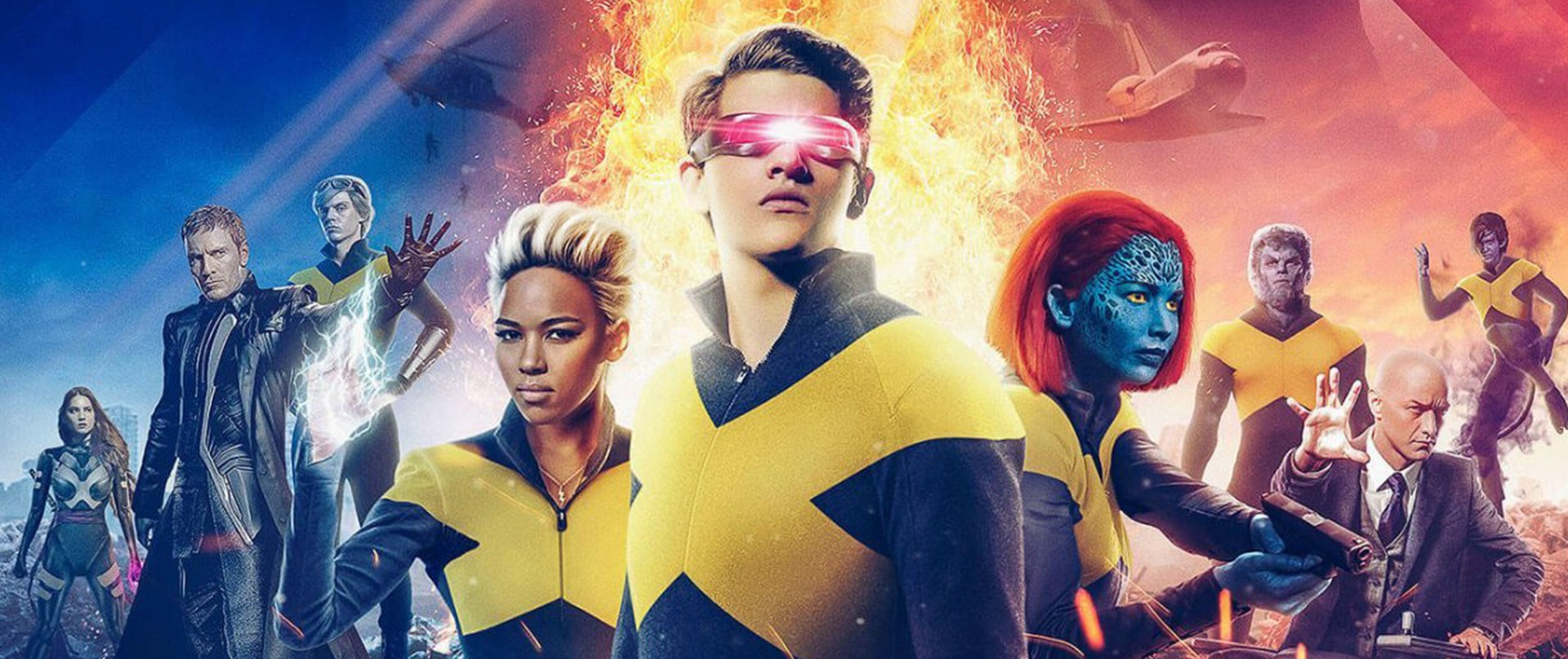
X-Men: Dark Phoenix marks the 10th installment in Fox’s X-Men film series, and it appears to be wrapping up a twenty year long story; paving way for The New Mutants in 2020. However, what should have been the most iconic X-Men story to send off our team of superheroes was instead a lackluster misstep that rivals X-Men Origins: Wolverine (2009) for the worst X-Men film. As I am not a comic book reader I will not be basing my opinion on the film as an adaptation, but rather a sequel and franchise installation.
Before continuing it’s best to remember that Marvel has a habit of numbering their multiverse, including film universes. For the sake of this article I will rename those universes to timeline one and timeline two. Events of timeline one (Earth-10005) are X-Men (2000), X2: X-Men United (2003), X-Men: The Last Stand (2006), and The Wolverine (2013), exclusively. Events of timeline two (Earth-TRN414) are X-Men: Apocalypse (2016), Deadpool (2016), Deadpool 2 (2018), and Dark Phoenix, exclusively, whilst the films X-Men: First Class (2011) and X-Men Origins are considered to exist across both timelines, with X-Men: Days of Future Past (2014) splitting the timelines. Logan (2017) is set in another universe unrelated and will not be mentioned further. With that in mind, let’s look at how they handle the Phoenix Saga.
Thoughts on the story.
Seeing how the entire premise of this film has already been visited in X-Men United and The Last Stand, it was interesting to see how the filmmakers planned to tackle the problem of giving audiences a fresh take on a story that even non-comic book fans had seen. While in the first timeline Jean Grey accidentally unlocked her psychic barriers set up by Charles Xavier to gain control of her full power, in timeline two it wasn’t so simple. Initially in Apocalypse it’s implied that Jean was still struggling to control her powers, and now in Dark Phoenix she’s combined with a cosmic energy that gives her immeasurable strength and is being hunted by a group of homeless aliens intent on stealing the power from her.
Both films hint at the persona, Phoenix, used by Jean. In The Last Stand, we’re presented to it as a ghost story by Xavier, and later shown the devastation it causes. Whereas in Dark Phoenix, we instead are told by Scott Summers that some kids called her Phoenix as a nickname for rising from the fire during the films opening scenes. The devastation that follows feels less like a dark persona taking control, and more like a bad driver shouting at everyone because they caused an accident.
In timeline one, the origin of the power and the Phoenix persona progress naturally from what the previous films have established; although not the saga depicted within comic book pages, it still gives a strong amount of tension throughout the third instalment.
The same cannot be said about timeline two. In the previous film we’re treated to an origin story that is now practically forgotten about, and a throwaway line about a nickname from some students. Jean struggles to find solid motivation until nearly two thirds through the film. By which point she’s had two accidental outbursts, and a blood lust that comes from nowhere. And even then her motivation is superficial as she gives up and wants to go back to the X-Men only moments later.
There were a number of side stories introduced in this film that were overshadowed by the Phoenix. Intentional as that may be, I feel it would’ve benefited more to spend more time focusing on how those stories motivate the other characters, including Jean. Xavier becomes an egomaniac who cares more on his public perception rather than the safety of the X-Men, to which Mystique is feeling unsure of her place on the team. Erik Lehnsherr/Magneto is running an off the grid island to help peaceful mutants live in isolation. Both of these result in the unlikely alliance of Hank McCoy/Beast and Magneto vowing to kill Jean, causing yet another divide and conflict between Magneto and Xavier. This is always a compelling thread throughout X-Men, but at some point it gets tiring having the two become best friends, fight, and go their separate ways.
Another story that gets delved into is the origin of the villains, the D’Bari and their leader Vuk. Aliens that lost their home world to a cosmic energy, destroying everything in its path, which they followed until it was absorbed by Jean. Their motivation as explained is to use the cosmic energy to destroy earth and recreate their own world. Whether it was the phoned in performance of Jessica Chastain as Vuk, or placing them as the secondary threat from the off, the D’Bari carried little weight. Sure, they were powerful and efficient, but they weren’t why we came to see this film. I was spending their screen time hoping for their scenes to be over.
What did you like about it?
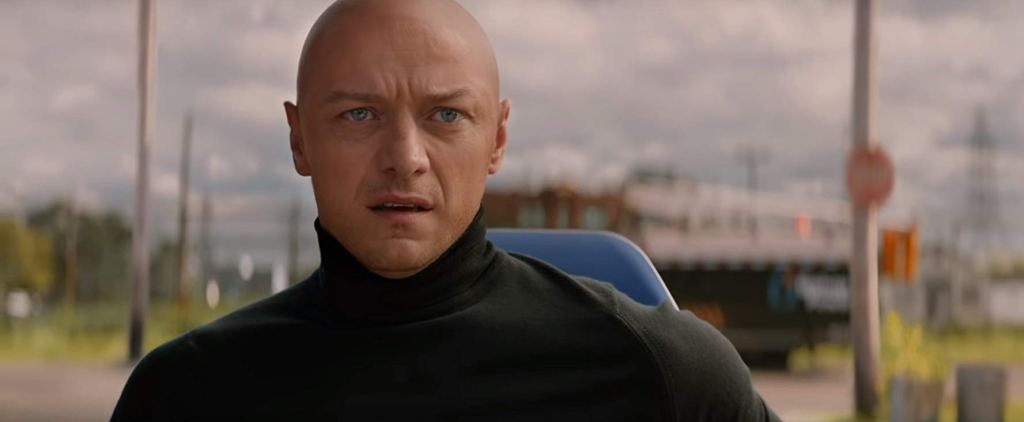
As always James McAvoy delivers an amazing and believable performance as Charles Xavier, this time focusing on his ego and the popularity of the X-Men, and for the first time ever I found myself resenting Xavier and his actions. Even during Sir Patrick Stewart’s run, I didn’t feel much after his admission of guilt. On a smaller note, I also appreciated Xavier’s outfit during the majority of the film taking inspiration from the animated series X-Men Evolution.
My favourite character since the franchise took a detour to the ’60s has been Michael Fassbender’s Erik Lehnsherr. In each film he begins trying to do the right thing only to fall into a well of anger and go on a murder spree. This film is no exception, and Fassbender gives the role all he can offer. The moment he appears on screen we can feel that this is the same man who lost every family member he ever loved – cold but caring, there is the slightest of fires behind his eyes. He refuses to stop fighting for mutants.
Notably Tye Sheridan and Nicholas Hoult both gave great performances as Scott Summers and Hank McCoy respectively, as did Jennifer Lawrence as Mystique.
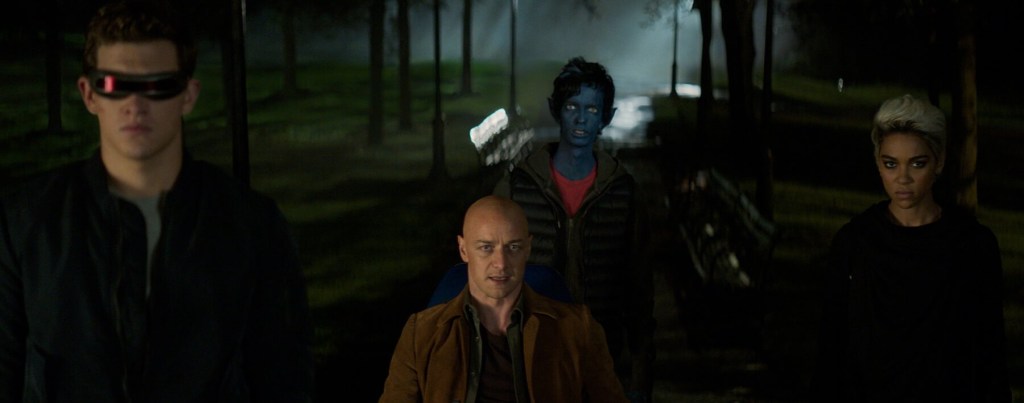
Another thing that X-Men has always been decent at is their ability to demonstrate mutant powers. Highlights including Jean causing everyone to see her as an old man, Storm flying over a train and battling the D’Bari, Nightcrawler mixing his teleportation with martial arts for a fantastic combat scene, and Cyclops using a specialized adapter on the X-Jet to fire his lazer beam while in flight. Special mention goes out to Jean’s hair that appears to have a power of it’s own as it floats weightlessly despite there being no breeze, a nice touch to the effect of the cosmic energy.
The most interesting thing about this film for me was how the writers tried taking risks that might not pan out, or sit too well with audiences. By which I mean they have a predestined future to set course for laid out at the end of Days of Future Past, and instead of following that path, the idealized X-Men future, they allow for faults or improvements. The problem with stories that have a predestined future – such as the Star Wars prequels or, more infamously, How I Met Your Mother – is that once the writers have decided to end the story in a certain way, they can’t make adjustments. Everything is certain, so nothing feels threatened. And this film takes those risks which, while they may not pay off for everyone, they did for me.
What disappointed you?
My first problem with the film came moments after the opening scene when we are shown the title sequence. Since the early X-Men films, a staple of the franchise is the high energy title sequence, the familiar X-Men theme and then the title card. Instead, we are given a cut to the title card in a place that feels more like it belongs in the Marvel Cinematic Universe, had it been edited by an amateur.
This then highlighted my second major problem throughout, which was the pacing. The writing seemed to be falling over itself trying to push for a direction to go in during the early moments of the film. Instead of allowing for characters to react, cause conflict, or force an effect on the plot, the plot moves forward anyway. Mystique was angry with Xavier, Cyclops was terrified for Jean, but instead of letting the characters invoke conflict, the plot decides for Jean to telekinetically explode. There are moments in between plot where characters go to react, but it’s so hurried that the plot takes control again.
Despite my praise for the actors, they do have their faults. During the original trilogy, the characters were able to grab the attention of anyone and had an air of authority. In such a way that they didn’t even demand it, it was willingly given. Sirs Patrick Stewart and Ian McKellen, and Hugh Jackman were all capable of this feat, with others still able to command some authority, such as James Marsden, Famke Janssen, and Kelsey Grammer as Cyclops, Jean Grey, and Beast, respectively. But this isn’t present in here. None of the actors are presented as the age we’re supposed to believe, with any level of authority. Their voices are too gentle, unseasoned, and lack strength. Nicholas Hoult, though well acted, comes across a little like a child done wrong on the playground. Tye Sheridan suffers the same problem in a scene while mourning, acting more like a wet blanket rather than the attitude given by his predecessor.
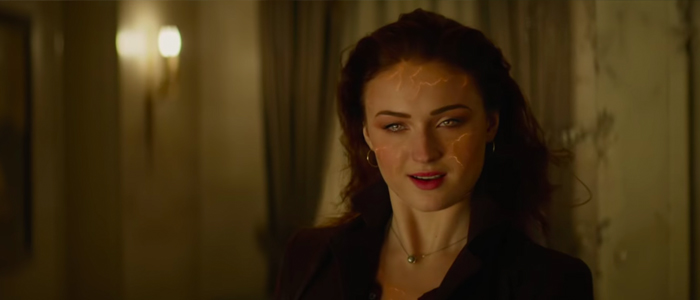
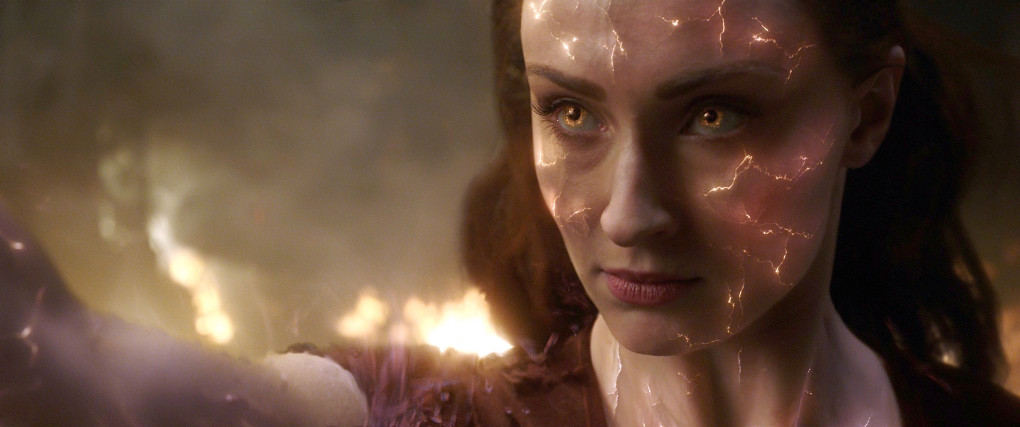
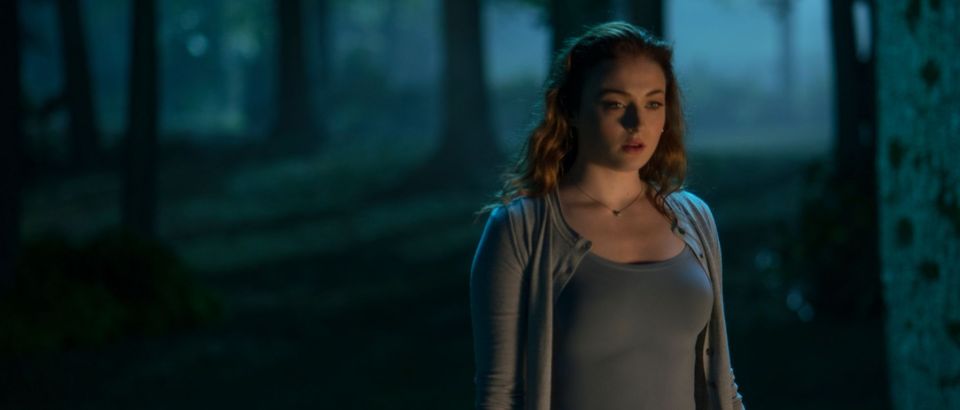
Unfortunately, the biggest let down was titular character, the Dark Phoenix herself, Jean Grey. Sophie Turner is known by most as Sansa Stark in the HBO series Game of Thrones which ended last month. In the previous film, Apocalypse, Jean is a footnote threat that comes to the foreground, enough even for Apocalypse himself to admire. But throughout the two films, all we see is a slightly awkward woman who develops into a slightly buzzed awkward woman, with moments of a cocky attitude when her powers are surfacing. In a scene between Jean and Magneto, two of the most powerful mutants in existence, we feel a level of fear when watching Magneto, who lets his powers do most of the talking. And then Jean’s power outclasses his. In most films this is where the audience has their breathe taken away. But not here. Instead Sophie Turner tries being intimidating, and it comes off, again, as a cocky kid. Had she not possessed the power to overwhelm Magneto, the scene would’ve just been laughable.
Dark Phoenix makes references to the earlier film First Class throughout, and makes acknowledgement to the characters time among the X-Men. But as a recap, First Class was set in the year 1962, with Charles and Erik being 30 and 32. Dark Phoenix takes place 30 years later in 1992, with Charles and Erik being 60 and 62. The other characters are also supposed to have gone through those thirty years, and yet none of them appear to be much older than forty, some looking as young as twenty. I’m not suggesting a recast of the characters, nor make up to age them up slightly. I’m suggesting that the writers stop insisting that they have to keep making a ten year time skip between each film. It has now become overused and meaningless. We no longer experience how these characters develop over those ten years, and their place in the world is less recognizable for audiences to care about.
Conclusion.
X-Men: Dark Phoenix was set up to fail by trying to deliver comic book fans one of the most iconic Marvel stories, and fail they did. Not because the adaptation was ambitious but because it failed to take any direction, letting plot threads flail around hoping to catch on, and ignoring them all. While some actors delivered amazing performances, they were buried beneath their co-stars lesser talents and poor writing. If this is the end of the X-Men as we know it, then they stopped a film or two too late. As a fan of the X-Men films, I would not recommend this film: 4/10.
 Royston D A